Hiring People You Meet in Bali: A Compliance-First 2026 Checklist
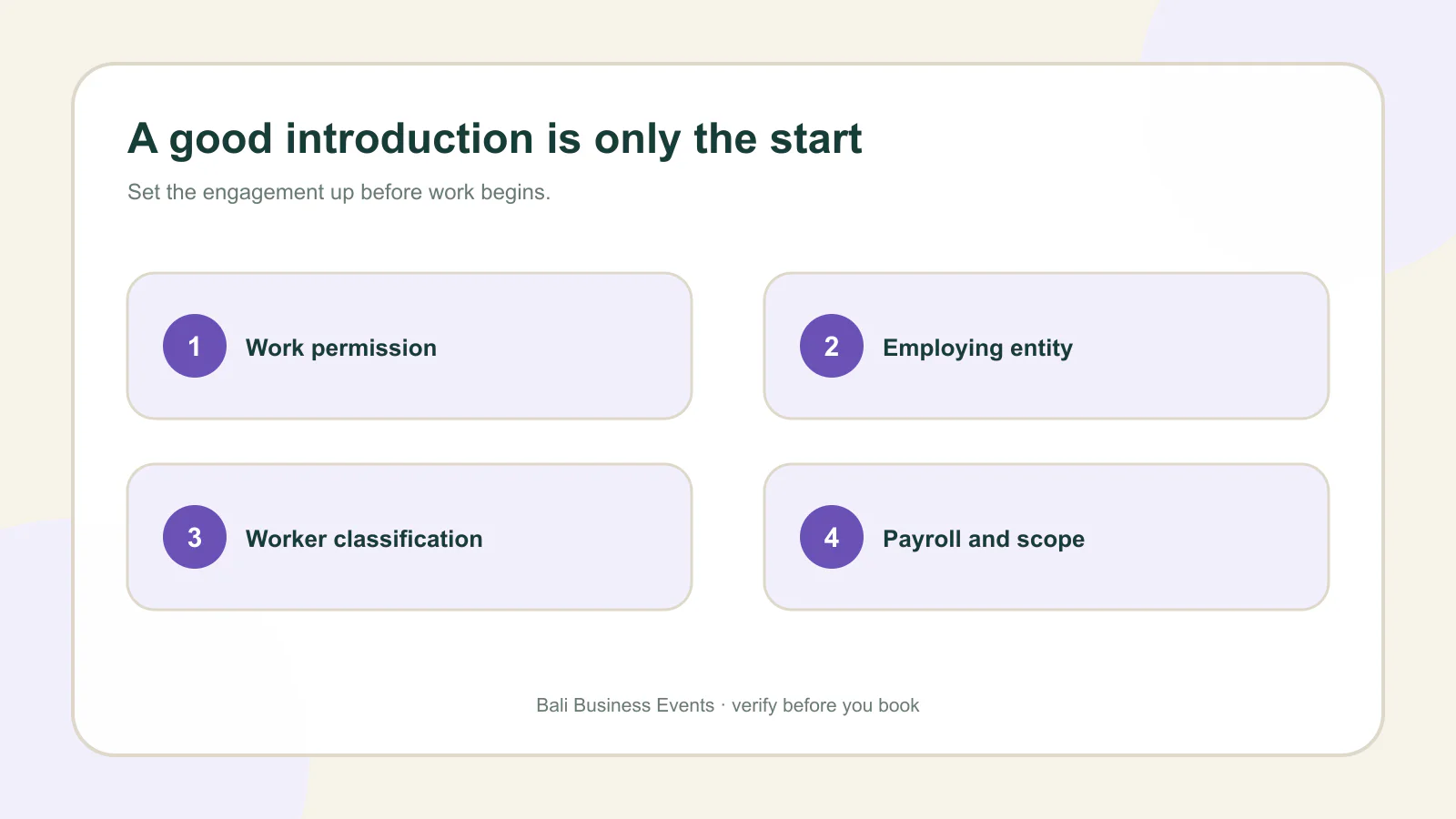
Image: Bali Business Events
A coworking introduction can reveal a promising candidate. It cannot tell you whether that person may lawfully perform the proposed work from Indonesia, who should engage them or how payroll, tax and worker classification apply.
This checklist is general information, not immigration, employment or tax advice. Cross-border hiring depends on the worker, role, location, engaging entity and actual working arrangement.
Evidence check: 27 July 2026.
Five facts to establish first
- Where will the person physically perform the work?
- What nationality and immigration permission do they hold?
- Which legal entity will employ or contract them?
- Are they genuinely an employee or an independent contractor under the applicable rules?
- Will the work serve an Indonesian entity, Indonesian customers or an overseas company?
Do not treat a candidate’s visa as “their responsibility” and proceed without checking. The company and worker can each have obligations.
Why the E33G label needs care
Indonesia’s remote-worker rules describe E33G in terms of an employment relationship with a company established outside Indonesia. The supporting documents include an employment contract with a foreign legal entity and evidence of annual salary or income at the stated threshold.
The official classification also restricts activities outside the authorized category. A foreign contractor, freelancer or founder should not assume that foreign revenue alone makes the arrangement eligible. Check the current E33G page and obtain advice for the actual relationship.
Hiring an Indonesian national
Hiring an Indonesian national for work performed in Indonesia can raise local employment, contract, payroll, tax, social-security and data-handling requirements. Forming a local entity or using an employer-of-record provider may be options, but neither is a universal answer.
An EOR is a commercial service, not a magic compliance shield. Ask any provider to identify:
- the legal employing entity;
- what it handles and what remains your responsibility;
- total fees and payroll treatment;
- ownership of work product and confidentiality terms;
- termination and dispute terms; and
- which legal or tax advice is outside its service.
Compare the written agreement, not just a sales page.
A hiring process that creates evidence
Write the role first. Define scope, location, hours, reporting line, decision authority and access to sensitive systems.
Obtain permission before checks. Tell the candidate what information you will collect, why and who receives it. Do not scrape private community groups into a recruiting database.
Use a relevant assessment. If a work sample is substantial or creates usable value, determine whether it should be paid and document the terms.
Verify proportionately. Confirm identity, claimed employment and relevant credentials with consent. A reference check should distinguish what was confirmed from what remains self-reported.
Resolve the engagement structure before the start date. Put the employing or contracting entity, compensation, currency, tax handling, confidentiality, intellectual property and termination terms in writing.
Limit access. Give the worker only the systems and data required for the role, then review access when the engagement changes or ends.
Using a recruitment partner
If you want outside sourcing or screening support, you can request a scoped conversation with White Glove Recruitment. Ask which countries, roles and services are actually covered and who provides any legal or payroll work. Availability and outcomes depend on the brief; no shortlist, response time or placement is guaranteed.
Stop and obtain advice when
- the candidate will work for or sell to an Indonesian entity;
- the person lacks clear permission for the proposed activity;
- the role may be misclassified as contracting;
- you plan to direct day-to-day work from another country;
- the arrangement could create local tax or corporate presence; or
- an EOR or agent will not identify the legal employer and allocation of risk.
Primary sources
- Directorate General of Immigration: Indonesia visa list
- Directorate General of Immigration: E33G
- Indonesia immigration regulation No. 22 of 2023
balihiringremote-talentfounderscompliancerecruitment